Flirting
with Dreams in the Valley of Stone
Yosemite Valley, CA
October 2012
"Whatever you can do, or dream you can, begin it. Boldness has genius, power and magic in it."
-Goerte
I grew
up in the traditions of western science and puritan pragmatism. Success is earned through work, luck is the
sum of preparation, a penny saved is a penny earned, etc. Claims that the universe provides if we ask,
attributing benevolence to the cosmos, the nebulous idea of “oneness”…this all
neatly fell under the “new-age” label.
Experiences in my journey as a climber are forcing me to challenge that paradigm.
Waking
up in Camp 4 the morning after climbing and descending Half Dome, I pulled on
slippers and a puffy jacket, staggered to my bear box, and huddled in a lawn
chair nursing a mug of coffee and a bowl of oats. Still exhausted from the Half Dome mission, I
was aware of basic sensations: my chilly hands welcomed the warm mug, my back
was a sore slab of meat, my thighs throbbed from my knees to my groin,
tenderized by the 5000 feet of vertical ascent and descent the previous
day. I stared blankly at a squirrel
sniffing at the lid of my food box which I’d failed to properly shut. The sonic soup of Camp 4 bubbled all around:
the hiss of propane burners, the clink of aluminum, garbled voices in English,
Spanish, Czech, Swedish, German…, the drone of motorcycles, dumpsters slamming,
garbage trucks backing up…I soaked in middle of it and took stock. I had accomplished a few goals, I was tired,
and I didn’t have any partners or any real plans. The prospect of another week in Camp 4 spent
hovering like a raven around campsites and the message board scavenging for
partners didn’t seem very enticing.
Maybe it was time to move on; after all, I had food, wheels, and some
cash still. I could pack up today and
leave for the solace of the road.
But in
my gut I knew I wasn’t quite done. There
were things I came here to do, goals built upon four years of dreaming.
In the
midst of these thoughts my compadre Jim wandered over with a cup of coffee,
wondering how Half Dome went. Before I
could respond we were joined by a European-looking man who I vaguely
recognized. He greeted us in familiarity
but I could not recall his name or where we’d even met him. As conversation unfolded I started connecting
the dots: a brief exchange in the parking lot, talking beta on Half Dome, the
Nose. Standard fare. A question shattered my thought bubble,
thickly accented, vaguely German:
“and
you, what are your goals?”
“Nose in
a Day, or Astroman,” I heard myself say.
Anton
(ah! That was his name) introduced himself; his partner had just returned to
Sweden, he had another week or so in the Valley, he was entertaining those
goals as well. Soon we had topos out,
discussing beta and tactics. Have you short-fixed before? No, me
either. A Dolt Tower run would be a good
idea, to see how we work together.
Unfortunately the sky promised rain the next day and regardless I was
too sore to walk further than the bathroom.
We agreed to rest and maybe do a little free climbing together tomorrow,
weather permitting. A clever idea
flashed in my mind. Have you climbed The Moratorium?
It’s a fun 3-pitch crack climb, not committing. I had a score to settle with that route and
had been trying in vain to rustle up a partner for 2 weeks.
The Moratorium
Despite
tender legs and a sporadic drizzle Anton and I climbed The Moratorium the next day.
I felt solid, psyched to finally send the crux, until I got to the
glassy corner and found the key fingerlocks seeping wet. I understand some people can crank through it
in this state but I’m not that strong, although getting on the rock with Anton
was promising. He is a strong crack
climber, a rare commodity in Europe, and we grooved well together. A taste of hard free climbing excited
something within both of us too. Hiking
down in the drizzle we agreed that after much time monkeying around on big
walls what we really wanted was some good pure free climbing, so we tucked The Nose onto the back shelf and began
to focus on preparing for Astroman.

I still
harbored doubt that I could climb Astroman,
but I committed to taking the preliminary steps. My friend Chris Barlow, who regularly sends
5.13, warned me, “before you even think of climbing Astroman, you need to CRUSH the
Rostrum, I mean top out and want more.”
Returning to the Rostrum would
be a logical step; besides, it was unfinished business. Anton had also climbed it once and fallen
several times, so we quickly agreed to rest a day and return for a redpoint
attempt.
The Rostrum
It was
one of those days that remind me what a whimsical gift it is to be a living
breathing human being in this wild world of cliffs and trees and sky. Once off the ground we hit a rhythm and
flowed through all the route’s demanding features: the delicate 2nd
pitch step-over, the sustained corners, the powerful fingercrack crux. Soon I was racking up beneath the offwidth
which had shut me down so hard several weeks before, and neither of us had
fallen yet. I knew if I could send this
pitch we’d have it in the bag; in the midst of the wide gash I was firing hard
to stay in but I simply refused to fall.
Perhaps it helped that Rob Pizem, a prolific desert crackman and author
of many inspiring routes, just happened to be in the party ahead of us and
cheered me on from above as I cranked heel-toes and arm-bars up the
offwidth.


Reaching
the anchor, only two steep pitches remained.
Anton, following, also sent the offwidth pitch (earning him massive
bragging rights over his Swedish cohort at Camp 4). I blasted up into last headwall pitch riding
a cresting wave of confidence. I wish
everyone on earth could share that experience: cranking up overhanging
fingerlocks and hand jams with 800 feet of air whistling beneath my legs, the
cliffs saturated in the crimson glow of the setting sun. There was no question of falling, I was a
creature that moved upward.
As dusk
fell Anton led the final offwidth and I followed him to the summit, where we
high-fived after a quality ascent and were surprised to find that we weren’t
spent at all, in fact we were jonesing for more. Basking in the elation of our team send, I
remembered Chris’ words and a shiver trickled up my spine; we were ready for Astroman. I gazed at the darkening horizon, mountains
fading into obscurity beyond, unknown.
Astroman
I tend
toward the analytical approach in my climbing, but while analysis is productive
during rest and preparation, it becomes an obstacle during the flow of
movement. Preparing for Astroman, I accepted two things: that I
had the physical ability to climb it flawlessly, and that if I let my mind
drift into its usual pitfalls—hesitation, focusing on fear, seeking comfort—I
would fall. I knew that regardless of
the confidence of preparation and the doubt of intimidation, once on the rock I
had to let go of both fear and expectations and let my body flow. We decided to break the climb into blocks
favoring our respective strengths. As
the Western crack climber, I would lead the Enduro Corner, the Harding Slot,
and the fist crack high on the route; Anton, representing European face
climbing prowess, would lead the Changing Corners and the final infamous
runnout pitch. Thus prepared, there was
nothing to do but begin.


Looking
back across innumerable days past, the day Anton and I climbed Astroman stands
out like a single shaft of sunlight in a forest. From the moment we left the ground we moved
upwards with purpose and belief. The
climb unfolded before us, offering exquisite cracks around every turn. My experience leading the Harding Slot was so
intense that it took me several days to begin understanding what happened. I am still learning. Somewhere in those 1100 feet of steep cracks
I encountered each dimension of my raw self: stamina, fear, joy, love, rage,
despair, hope. At the end of the day,
Anton styled the final pitch, boldly pushing through the runnouts, and we stood
on the summit of Washington Column watching the sun set over El Capitan. We’d free climbed Astroman; I’d fallen twice and Anton once. Content, we watched the
light fade over the valley, savoring the last sips of our water before
beginning the descent.
NIAD
The next
morning I rolled out of my tent, stretched, and felt the leaden soreness of my
back and limbs. I surveyed the daily
Camp 4 hustle and let loose a thick, contented yawn; I was done. I had now accomplished everything I came here
to do. I ambled over to the Swedish camp
with a mug of coffee and joined Anton in cooking up a royal breakfast,
entertaining the Swedes with harrowing tales of Astroman and basking in the revelry of our ascent. I began to think of moving on; I had only 4
days left before visiting my family on the coast, I was sore and depleted from
a week of hard climbing, and felt generally content about my Valley
season. I half-heartedly organized my
food box, tinkered with sorting gear, but something was nagging at my brain,
preventing me from packing up.
I have
never been successful at fooling myself.
Passing a Big Walls guidebook
lying on the picnic table I knew what was still missing: that elusive gem, The Nose
in a day. When John Long, Billy
Westbay, and Jim Bridwell first accomplished this goal in 1975, it rivaled the
greatest climbing achievements of all time.
Since then a NIAD ascent has
become such a benchmark of big-wall competence and stamina that it has become a
well-recognized acronym (as if climbers needed to become more cultish and
nerdy). The first dozen or so NIADs were climbed by only the world’s
elite crack climbers, but as gear, tactics, and general skill base has improved
over the past 35 years, hundreds of “recreational” rock climbers have managed
the feat.
Still, I
did not seriously consider myself ranked amongst the NIAD class of climbers. It’s
just so damn big! Staring up at El Cap
from the meadow and thinking about ascending that vertical ocean of granite in
just one day seemed ludicrous. After all, it had taken Jim and me three days
to climb it before. Granted, we were
hauling, we were both free climbing, yada yada… despite all the things that
made our ascent slow, I still couldn’t visualize climbing all that terrain in
one day. The goal of NIAD hung just over the horizon of
possibility, like a peak beyond the next ridge: something to admire, to
daydream about, to make small preparations for a serious effort next year.
Once the
seed of a wild objective takes root in the malleable tissues of my brain,
nestled amongst Spanish verbs, constellations, trig equations, the location of
my car keys, the minor pentatonic scale, mineral classifications, daily
reminders to floss…it nudges for attention like the rest of its neighbors. NIAD is
big, but not in a realm completely beyond my experience. In the Black Canyon of the Gunnison I’d
pulled off a handful of Grade V free climbs in the realm of 2000 feet, all
within 12 hours or so. These were big
days, tiring for sure, but not unmanageable.
For NIAD we would use speed
tactics too, methods I had yet to learn, but I could put in some time learning
to short fix, maybe make a few training runs up sections of the route, and
build towards a one-day ascent next season.
I
resumed packing, contemplating a long-term training plan to gain the skills and
stamina for a future NIAD, when my
phone rang with Jim on the other line.
“Brother,
you wanna go for Nose in a day?”
I
froze. Seriously, what was going on
around here? I gave him some noncommittal
reply about resting a few days and strategizing.
“Naw we
gotta do it tomorrow. I’ve gotta get to
the Bay Area by Friday. Just rest real
hard today, you’ll be fine. You down?”
I stared
at the phone. I was sore and exhausted
from most arduous rock climb of my life the day before, not to mention 4 other
strenuous climbs in the past week. My
body needed rest, a couple days of lying in meadows and eating and full nights
of sleep. I’d never short-fixed, just
examined diagrams. I’d rope-soloed only
once for a few bumbling hours. I didn’t
even know if I could physically do
that much climbing. This was ludicrous.
I have
always held great respect for rock climbing’s pioneers. Today rock climbing is a mainstream sport; it
can be completely safe. With Supertopo
guidebooks, beta sprayed all over the internet, cams of all shapes and
dimensions, cell phones, satellite communication, bolted anchors, etc, a party
of intermediate climbers can control all the variables in a rock climb except
for their own performance, effectively reducing the level of adventure to
background noise. With prior knowledge,
plentiful modern gizmos, communication, and escape plans, we can box an entire
2000 foot cliff conveniently into the comfort zone, scaling it in security
before sunset and returning to the order of daily life. We’ve learned how to turn adventure into a
workout, and while it fits well into a calendar, there’s something essential
missing.
The
climbing pioneers are set apart because they were willing to launch upward into
chaos. They were engaging in adventure,
really coming face-to-face with fear of the unknown. The first generation of Valley free climbers
were teenagers and college dropouts who were willing to risk injury and
sometimes death to test the radical new idea that a human body could free climb
these granite cracks. Steve Hong climbed
sandstone cracks in Utah, pounding hexes into splitters with a hammer for
pro. Leighton Kor, Ed Webster, Earl
Wiggins, Jimmy Dunn and crew spearheaded the era of “a rope, a rack, and a
shirt on your back” in the Black Canyon, re-writing the rules that said you
needed fixed ropes, ascenders, and several days to climb those formidable
walls. These climbers all had their
epics and close scrapes, but they had the courage to push forward into the
unknown, again and again, just to see what’s up there.
The
phone was still sitting in my hand.
“Drew, you there?” Would the
pioneers have waited until their preparation, training, and strategy guaranteed
success so completely that they had nothing to be afraid of? There had to be something to be said for just
stepping out in faith. After all, we
didn’t make it out of Africa because we followed the example of other apes at a
safe distance.
“Aw
hell, let’s go for it.”
“Nice, I
knew you’d be good for it. Let’s meet
this afternoon and talk strategy. Eat
your bananas.”
I brewed
another mug of coffee and sat heavily in my chair.
Our
strategy was simple: we’d lead the same blocks we did before so we’d be
familiar with the terrain. We pared down
the rack to essentials and gathered a handful of bars and gel packets while
debating the virtues of 4 vs 5 liters of water; neither would be enough but we
couldn’t carry more. We scrutinized Hans
Flourine’s Speed Climbing! book,
discussing where we could use each other as counterweights through the
pendulums, a strategy that looked good on paper but we’d never practiced. After a brief discussion we decided to take
just one rope; a second rope would allow us to bail from any point on the
route, but we both knew we climbed better when committed. Would Jimmy Dunn bring a second rope? Hell
no. That night our gear sat ready next
to the tent, alarms were set for 3AM, and I tried in vain to sleep. I haven’t been kept up at night before a rock
climb since my days of cutting my teeth on multi-pitches in Colorado. The hulking mass of El Cap loomed over me in
the stuffy tent, oppressing my thoughts.
What the hell was I trying to do?
Who was I to attempt such a massive goal? The image of us dangling from our single rope
on the upper ramparts of The Nose at
night, dehydrated, depleted, and helpless, plagued my mind until the alarm went
off at 3 AM and it was time to shut up and pull on the man-pants.


There is
nothing quite like the exhilaration of scrambling up to the base of a rock
climb in the close silence of night, not knowing what the day will bring but
beginning it with a full head of steam anyway.
The rhythm of short-fixing and rope soloing is very enjoyable; we remained
in constant motion for hours at a time.
Somewhere about midday, as I climbed familiar terrain towards the base
of the Great Roof, it dawned on me: we
can do this. A Russian team let us
pass them on the Great Roof pitch and I hauled up his gear on my ladders, tied
off the rope at his belay, then launched into free-climbing up the Pancake
Flake, intent on keeping momentum despite the full heat of the day. My second lead block continued through the
Changing Corners; we had 4 strenuous pitches to go but my energy was wilting
under the intensity of the sun. At a
gear exchange I pulled up our backpack to snag a goo packet and a few gulps of
much-needed water and continued up.


After scrapping up a handcrack on what felt like my last reserve energy,
I mantled onto the Camp 6 ledge dry, panting, and totally worked. I fixed the rope for Jim and was relieved to
be forced to wait a few minutes for Sam and Will, the other party doing NIAD
that day, to climb the Changing Corners.
4 PM, huddled in a scrap of shade on Camp 6, is the most exhausted I
have ever been on a rock climb. I had
only one more lead in my block. You can
always do one more. Jim jugged up onto
the ledge, handed me a goo packet and started racking me up. Despite an overwhelming desire to lie down,
once my fingers and toes were on the rock, my reptilian brain took command and
I was leading again, flowing up the rock like this is all I knew how to do; I
was a skeleton and a nervous system that ascended, I had no other identity, no
past or future. After a sun-dazed blur
of motion I clipped the anchors, fixed the rope for Jim, and collapsed in my
harness, as well as one can at a hanging belay.

Jim
jugged up to the anchor and unleashed the energy he’d been saving for the last
11 pitches, firing up the strenuous 5.10+ lieback despite his fatigue and
sending it clean. I relaxed into
belaying and jugging mode as Jim took us up the remaining pitches through a
glorious sunset and into the night. Jugging the final free-hanging pitch felt like
the hardest thing in the world, but I pulled onto horizontal ground and
stumbled up to the tree atop El Cap in a tangle of rope at 9:30 PM, high-fived
Jim, Will, and Sam, and indulged in the amazing luxury of sitting down.

Despite
little familiarity with speed techniques, fatigue from a week’s climbing, and
several major rope-cluster incidents, we climbed The Nose in 16:45, roughly
what Long, Westbay, and Bridwell accomplished 27 years ago. We had done what I thought was impossible
merely days before. After sharing the last
Cliff Bar, we shouldered the ropes and gear and began a 3 hour descent down
slabs, thickets, and fixed ropes towards the cache of water, pretzels, yogurt,
and malt liquor we’d deposited on the valley floor, on the other side of a
long, long day.
Swedish climber Eva styling a crux on
The Rostrum
Anton firing hard on the final steep pitch of
The Rostrum
Anton always maintained high spirits, even in the depths of the Harding Slot on
Astroman
Anton leading into the crux "changing corners" pitch on
Astroman
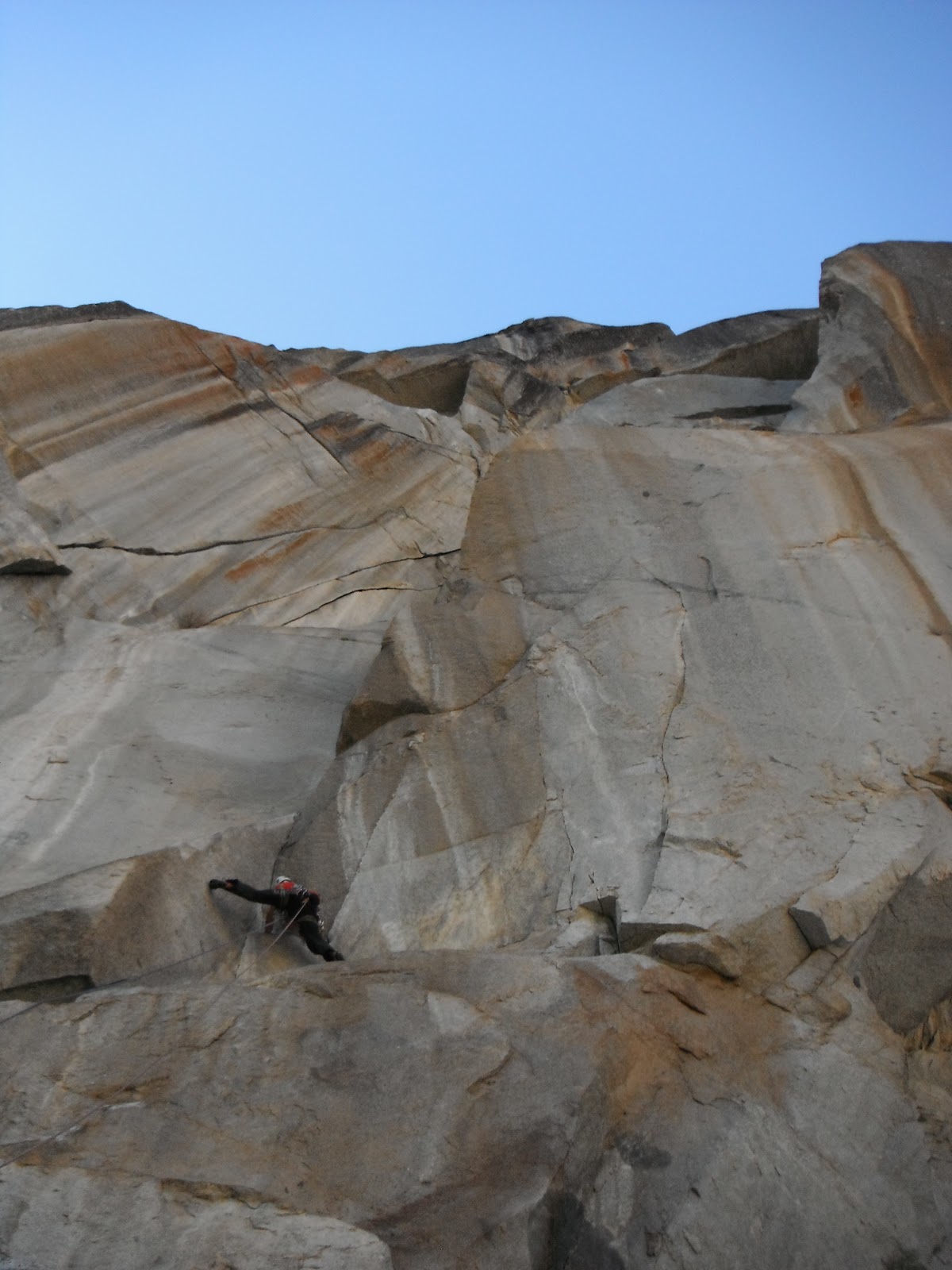
high on Astroman
Success atop Washington Column and the hardest rock climb I've ever done
Sunset over the Valley
Rush hour on the Great Roof. The other party doing NIAD: Will Kahlert (green shirt) belays Sam Hennessey up the Pancake Flake (above). Pavel of the Russian team ascends immediately beneath the roof, I am aiding up his gear behind him, and Jim (blue backpack) ascends our rope to the anchor. (Long-range photos were shot by Tom Evans, www.elcapreport.com)
Myself hauling up Pavel's gear toward the roof.
More shenanigans. Pavel belays his partner below while I begin rope-solo free climbing up the Pancake Flake above him. Jim ascends below in the shadow of the roof.
Jim leading off Eagle Ledge