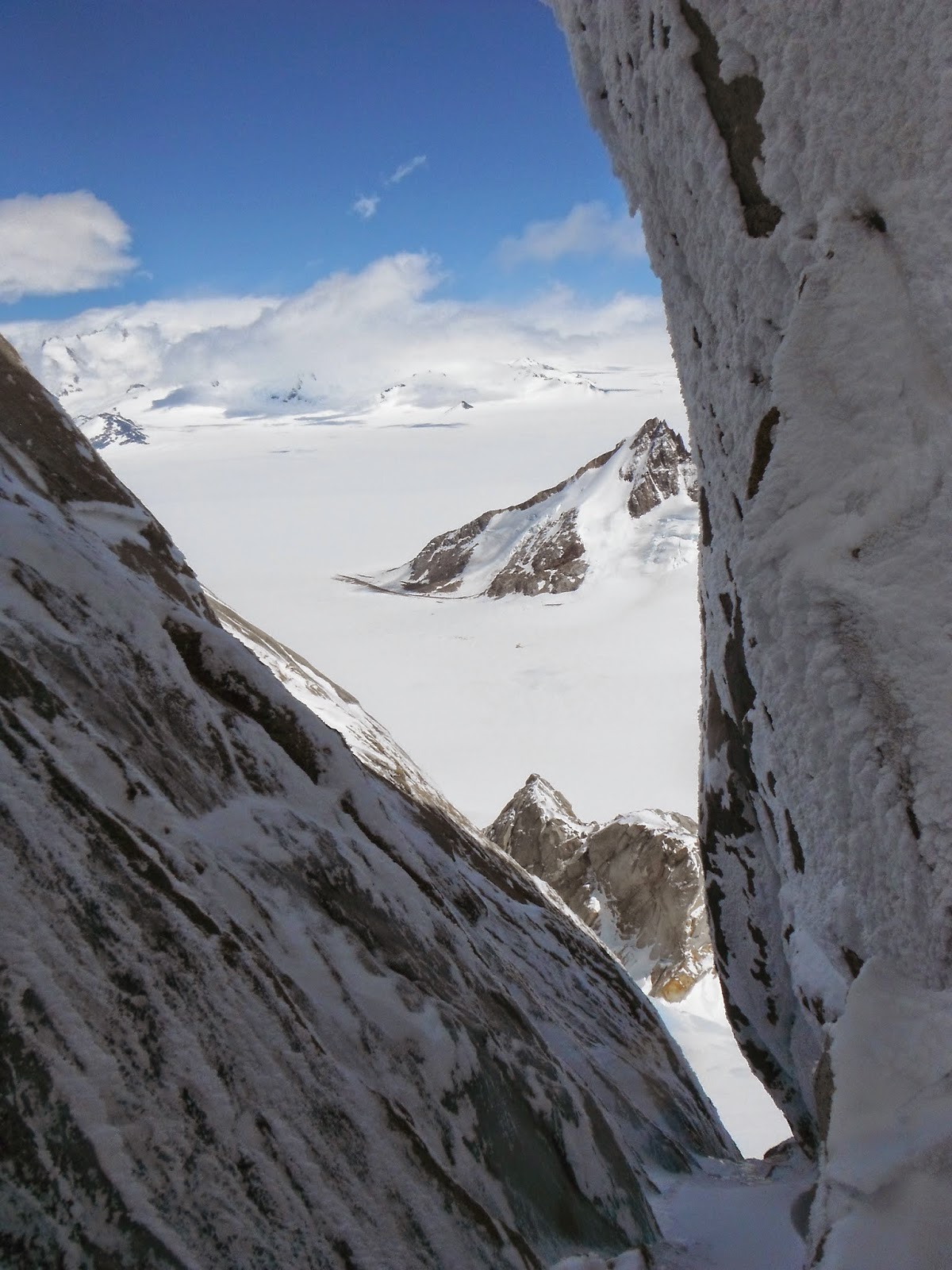
Showing posts with label Alpinism. Show all posts

Thursday, July 30, 2015

Golden Hour in the Wind River Range


Sometimes, the balm of the day is Happy Hour, when we can leave the stress and bustle of work and bike over to a friendly watering hole to enjoy a cold tasty brew. This is the time to relax and banter with friends, and enjoy a slower pace.

I enjoy the libations of Happy Hour sometimes, but the real balm to my soul is the Golden Hour, that magic time just before dusk when the sun does something ridiculous and paints the whole world in rich velvet rays. It's as if the sun realizes that it's about to leave and throws a final burst of its purest light over the world, a parting gift.

The Golden Hour is a special time. It's the time of my best efforts, but not my hardest...it's a brief relaxation of the day when gravity and fatigue lose their potency. These are the times when I float down the trail on renewed legs and climb with renewed vigor, buoyed upward by a new lightness before the close of the day. In winter, when I see that golden hue out the office window before I leave, I see the chocolate walls of Indian Creek in my mind's eye and recall days upon days of floating up splitters in the light of the fading day, scaling the improbable cliffs with no more effort than breathing.

As JD and I hiked over Jackass Pass into the Cirque of the Towers this weekend I couldn't help continuing to look behind at the splendid silhouette of Lost Temple Spire jutting into the horizon behind us, bathed in the light of sunset. "Man, wouldn't it be sweet to be up there right now", I kept saying. He said something about the annoyances of rappelling in the dark and I had to agree, but maybe it's worth the cost... 

We enjoyed a fun mellow day scrambling to summits in the Cirque and enjoying spacious views of the range, then returned to camp for a meal in the early evening. We'd been talking about the Lost Temple Spire too much to let it lie in the unknown future anymore. Satisfied with some Raman noodles and spicy peanut sauce, we broke camp, packed our bags and hiked south over the pass with the Spire floating before us like a sentinel in the sunset. Golden Hour. "Man, I'd like to be up there at this time tomorrow."

JD scopes the chiseled south face of Wolf's Head, some of the cleanest cracks in the Cirque.

Usually, I hit the Golden Hour at the end of day-long climbs, massive efforts that drain me to the core, and the rich thick sunlight comes as a blessing at the end of the day when I need a final boost of energy. The spire in our view is only six pitches tall, totally feasible to climb and descend in half a day. To be up there near sunset, we’d have to start late…

We were a little haggard from poor rest before the trip so we luxuriated in ten hours of beauty sleep at Big Sandy Lake and enjoyed a casual morning stretching and drinking coffee in the meadow. Buzzing mosquitos were annoying but hey, you forget all the annoyances easily. We set off for our destination with a super-alpine start of 9:30 AM and enjoyed the lovely walk to Black Joe lake (wrong way…oops), crossed the shoulder of Haystack to correct our error, and took an exhilarating dip in the cold clear waters of Deep Lake underneath the majestic prow of Lost Temple Spire.

Lost Temple Spire beckons from Jackass Pass


After a long scramble up from the lake we enjoyed great climbing on the Wind River granite as we inched our way up the Spire via Separation Anxiety. A sparse description in the guidebook kept things exciting, as a 5.6 pitch held a surprise no-fall-zone 5.9 mantle and a “5.0 traverse” involved inching out on sloping blocks over the sheer north face that drops off a thousand feet to the glacier below. The proud skyline of the tower was accordingly strenuous, with a burly “5.9” fist crack followed by the route’s signature pitch, a 65 meter hand crack. As in a 65 meter pitch with 63 meters of hand jams. With four red and three gold camalots on my harness, I gazed up at the immaculate splitter that cut the white granite above us beyond view, and felt my hands tingle with anticipation. The pitch was pure joy, perfect jams with a gulf of air beneath, so little gear it wasn’t even worth thinking about it. At the rope’s end I was huffing and puffing and couldn’t help the huge grin on my face.

We climbed back onto the sunlit west face as the day grew old and the light grew thick with the molten sun. We forgot the fatigue of the day and the bustling wind and worked our way through the final problems to the top of the Spire in a golden world of sky and stone. On the summit, the Wind River Range extended before us in unending waves of peaks and valleys, ridges and cliffs and dizzying vertical walls, each one holding the promise of unwritten trials and discoveries. At these times, in the dying sunlight, the future spreads as far as the mellowing horizon, in all directions, tantalizingly close.


We’d earned our time in the Golden Hour, and had to pay up too. Rapping the south ridge on-sight in the dark involved some uncertain rope-stretching rappels, some manky anchors, and an entertaining half-hour while I crouched in an alcove tied to a small block while JD finagled an anchor somewhere above me. The mountain’s geometry forced us down narrow ledges away from our packs and we had to descend a long way down and scramble the whole way back up, our feet swollen in climbing shoes. It’s easy to get dejected on a long slog back to camp, but the beauty of the place kept our spirits high. We sated our raging thirst with the cold waters of Deep Lake and ambled down the slabs of the valley, glittering in moonlight. We only got four hours sleep before waking to the buzz of mosquitos and a threatening sky but jammed some coffee and oats down the hatch and made the trek back to the car, tired and sore but happy with the memory of the Golden Hour still fresh on our minds and worn into the creases of our hands. 


Inspiring terrain for days


Great exposure and some steep "5.9" jamming

The money pitch: 2.5 inch splitter for days.

The sheer north face of the Spire has fueled my dreams the past few nights. There still be glaciers in these parts!

JD finishes 65 meters of hand jamming

dreamy terrain

alpine mariachi

They don't call them the Wind River mountains for nothing...chilly breezes on the north prow of Lost Temple Spire. Can't wait to get back for more!


Thursday, January 8, 2015

Time Dilation: Musings from a season in El Chaltén, Argentine Patagonia

I can't make the southern migration this year, so this goes out to all the monkey who have ventured south to chase big dreams in the world's worst weather...


Time Dilation

There’s a land at the end of the world that sleeps and wakes in its own time. It lies alone in the vastness of the ocean, the only land piercing otherwise unbroken sea. The wind whirls around the Antarctic vortex with the force of a spinning planet and slams into this land with cold indifference, a mere speedbump on its eternal journey around the pole. It is a land of fire and ice, stone and sky, where the stoic icecap feeds torrential rivers into broad sparkling lakes that spread out into the endless brown of the pampas, and it all quivers and breathes beneath the incessant wind.

There’s a town in this land at the end of the world where wanderers and athletes and dreamers collect every austral summer to sit at the base of the mountains and wait for their chance to venture upward. They come from every continent, represent every type of lifestyle and profession, and they arrive laden with bulging duffels and potent dreams. They bring the newest ropes and mountain boots and alloy crampons, they bring carbohydrate goo and freeze-dried meals and US dollars and empty memory sticks for their cameras and hope, hope, hope.

People bring their stories. Some leave whole narratives at home, some have no home except the pages they are continually scripting. They all come to this town at the land at the end of the world to write new chapters to their stories. They come to observe, to taste, to experience…but once they stay long enough they realize that regardless of the success or failure of their personal efforts, they have become characters in the story of this place.

Some came and suffered and returned to their homes. Some saw their dreams crushed and left in frustration, never to return. Some fell in love and set a new course for their lives so they could come back. Some bought houses there, some got famous, some left in leg casts, some left in worse. Some did not return, and their absence haunts us with more questions. Some removed the scars of ugly history and ignited worldwide debate, some forged new history, some pushed beyond their own limits, some suffered cold nights and watched the sun rise more beautiful than they’d ever seen before.

Just as the wind blasts incessantly over the icecap towards the plains only to spin around the planet and come back, people come and go from this land, but their stories keep returning.

Wind


One AM, stagger through the headwind across the lawn into the campground bathroom and the door slams shut behind you. Inside, there’s no escaping it, the old structure is alive with it, the old slats whistle and creak and the roof stutters beneath the gusts, and there’s a man in the stall, squatting on the shitter with a shirt wrapped around his head, smoking inside it. He looks up, the cigarette coal crackles and smoke seeps from the collar below his chin and out his mess of hair, his shoulders begin a shrug and give up the effort. “The wind,” he says, “the wind,” and his eyes stare past you though the wrinkled shirt, into the dark beyond the door that shudders on its hinges.

Morning, the windswept streets lie empty in bright sunlight and droplets of water fall in a light spatter on the cobbled sidewalks; they will fall all day despite the warm sun, borne by the wind from the white miasma of cloud hanging over the mountains. An elderly man takes his morning walk, in leather shoes and well-worn corduroys and a high-collared jacket. He steps with his cane past a sleeping dog, leaning at a hefty angle into the side-long wind, free hand clutching his beret to his head.

Try


Despite the pre-dawn chill we are stripped down to thermal tops while booting up stiff snow towards the col. The path turns to loose talus and our pace slows, and as the gulley tightens the wind increases and forces us to don our shell jackets; we carry on. The terrain steepens and we climb upwards with hands and feet, seeking dry grips amongst smears of slick verglass as the wind harries our bodies. At times the gusts rush down from the col with such force that it’s all we can do to hold our place, clutching the rock and closing our eyes against assailing spindrift.  Thus scrambling in bursts between gusts we gain the col, strap on crampons and start up the steep glacier as the eastern sky begins to lighten. Above the bergshrund the snow glows pink as the sun rises over the broad expanse of the pampas. We swing axes into the crisp neve and front-point upwards, light spreads across the world and in the protection of our chimney we enjoy the illusion, for thirty minutes, that the wind has stopped.

Gaucho


The gaucho draws his long facón blade from its sheath on his belt and carves even slices of steaming meat off the roasting flank. As we hold out a platter he stacks it with slabs of grilled sheep until satisfied with the harvest, then wipes the oily blade in a loaf of bread and sheathes it again, where it will wait until the next asado. He carries the laden tray easily against his paunch and sets it on the table with flourish, sizzling meat glistens in the firelight and the whole barn glows with the aroma of night and laughter: wine, smoke, and warm fat. The gaucho has lived here since 1983, before the government decided that a town should exist, and rough-handled instruments of his trade hang from the barn walls. These days the gringos come in larger numbers, lured by grocery stores and insipid internet and magazine photos, and he still pulls the facón from its sheath to carve meat around a fire.

Calm

How do you descend from a 500 meter spire, moving safely through vertical terrain and objective hazards? Inside, a voice called ego pleads without reason to be out of the danger zone, to be safe on flat ground. In a glance we see this silent plea in each other’s eyes; we don’t dare voice it. In this austere world of rock, wind, and vertical sky, where a single mistake can kill you, when the child inside you yearns for nothing but safety, how do you make it down? With patience. Without ego, without panic. Without fear? A little much to ask for this guy, for us mere mortals. At moments of doubt, staring down unfathomable distances of rough terrain, I feel a swell of terror rising in my chest. But the wave must not break. As alpinists, we make that commitment before we leave the ground. I acknowledge the wave, relax into its motion and let it pass. “If it weren’t for climbing we’d all be surfers,” the sage said. Maybe we still are.

So how do you descend from a 500 meter spire? Calmly, a compilation of small steps, executed with precision. One. Two. Ten Thousand.

Talk

We wait, we hope, we pack and re-pack and eventually un-pack, AGAIN. We cook. We forego cooking to eat what someone else cooked. We go on dessert binges around town, we eat ice cream at Domo Blanco the second time…that day. We stare at the meteogram. We talk. Mostly we talk shit. We make plans, we talk about going bouldering, yeah bouldering! We talk about it and finish our meals and talk and fill a water bottle and talk and run back to the hostel to grab the shoe/chalk bag/speaker system/beer that we forgot and we stand outside the Centro Alpino apartments talking with the residents as two members of our delegation try to track down four of the eight bouldering pads in El Chaltén and in the meantime I need to go find Joel and in the process give a kiss and hello to all the members of Teresa’s family in La Lucinda and might as well say high to Jason and Kevin who are sipping tea at their computers and talk to Neal and Carlos hanging out inside and eventually I get back and we’re still all hanging out talking shit outside Centro Alpino and finally one pad plus one pad plus the promise of two more in half an hour equals enough critical mass to start walking and we FINALLY start walking out of town to go bouldering, talking all the way.

Drifting

7 PM, wandering. I’m hungry but the sun still hangs high enough above the horizon that my body doesn’t see the day winding down. Another day in limbo. I could mend gear, I could read, I could eat empanadas, but the sun says the day is still happening, so I walk the streets of El Chaltén trying to not spend pesos, but with a wad of them in my pocket nonetheless. At La Lucinda, Ben and Joel are poring over a map between sips of tea. The creased paper covered in squiggles hints at the tortured coastline and desolate ranges that make up Patagonia: the topography of chaos. We discuss distances in days, the weight of packrafts and how to chop a bike frame into packable parts, and dream of the adventures that lie within those blotches of primary color. The tea is hot and outside a sign beats upon a wall in the wind.

Jenga

For two hours, every rock we’ve stepped on has moved; I look up-valley and the same interminable scree continues beyond the edge of sight. Contemplating the distance is so demoralizing that I pull my gaze back to my immediate vicinity: the next 20 feet, the next six feet, even the next two feet require thought. Each rock is its own puzzle, with its own angles and texture and its unique position of the infinite game of Jenga we’ve inadvertently stumbled into. Will the rock shift when I weight it? Can I bridge my foot over two rocks together? Will it drop the rock above it onto my ankle? Could I walk back with a bum ankle? With a fractured tibia? Each rock…each motherf*!#ing rock, for two hours, three hours…tiny rock crystals work their way into our socks and my heavily laden pack slowly abrades the skin off my hip bones. We’re playing a game with one rule: don’t topple the blocks. Five hours later we step off the lateral moraine onto the rubble-strewn Torre Glacier, where we can almost walk naturally without scrutinizing our next step. We stop to rest in silence and I fill my canteen from a trickle of cold, pure meltwater. Looking up-valley we can see the Mocho shrouded in snow and imagine base camp nestled at its base, with an empty tent-site sheltered by boulders. “Well, maybe people go the other way around the lake.” “Yeah. Maybe.”

Movement

At the col that morning we’d scoped the route, trying to keep our balance on straddled legs braced against assailing gusts of wind. The terrain looked casual but the conditions…we could see snow on ledges all over the face, and it was hard enough to stand down there. But we came all the way here to the tip of the end of the world, and I have a flight in 3 days, so I took the rack and begin climbing in gloves, hood zipped tight.

Now we’re getting what we came here for, movement in the mountains, under a blue sky and above a jagged world of rock and ice. Handholds lead to sequences, sequences surmount features, features begin connecting into the totality of the mountain and the details cease to matter. We move upwards, reading the braille cyphers of the mountain with our fingers and feet. The mountain presents mixed media: in a windy notch Dave dons rock shoes and weaves between jagged gendarmes; I lead out across a hanging snowfield and sheath my axe on a gravel perch beneath a stone wall dripping with meltwater. High above my gear, I clear snow from a granite gutter and jam a gloved fist in the icy sludge. My approach shoes smear on clean rock running with sparking rivulets of water. This is not terrain one should fall in, but the sunlight and the widening expanse of space buoy us upward; we move through each nuance in rhythm towards the next, more focusing on the flow of the song and letting each note pass in its own time. Alpinism is jazz, an improvisation of formal methods to flow with a constantly changing rhythm; it is the art of dynamic harmony.

Time pulses with the rhythm, stretching across fluid pitches and compressing into finite moments—weighting a tenuous off-finger lock, checking an Alien’s lobes in a flared crack—and expanding again. Like musicians, the more we feel the beat the less we remember ourselves, only immediate facts: I have twenty more meters of rope, I have three cams left, my left shoe is wet. I am hungry, I am cold, I am alive. I sip water from a crevice and stare across to the knife-edge ridge of Cerro Pollone, trying to comprehend the expanse of the icecap beyond.

At the crux things are getting real; the gloves come off and I jam bare skin in rough granite, fighting for purchase, trying to read the sequence above. Time contracts; the details matter again. A widening crack choked with intermittent snow guards overhanging terrain. A chockstone seems to be the key to the puzzle, but it is covered in ice.  In the mountains there is no room for hesitation, we must keep moving; I know what I have to do. I stem up the clean corner armed with the nut tool and press my feet hard against the walls while I hack ice off the chockstone, enough so I can pull on it securely. I stem a foot higher and I can clean snow out of the next jam, then step down to rest. Above, the way is now clear. Three breaths, and execute: the rhythm collapses into total focus. The crux is perfect, just enough features to let me through, nothing more.

Fatigue

The LCD display on my wrist slowly drifts into focus: 3:05. I collapse against a boulder and stare back across the moonlit glacier, waiting for Seth and Neale’s lamps to emerge over the swell of glacial ice. Since our brew stop at 6 PM it was eight rappels down the ramp, a tenuous traverse over soft snow across the bergschrund, and an hour of careful travel on the steep crevassed glacier until it leveled out and we could finally just walk. A long walk, below the hulking mass of Fitz Roy bathed in moonlight and not a calorie left between the three of us. Why did I pack food as if I was climbing some classic in the Black Canyon? Some things I’m still learning the hard way.

The headlamps arrive and we slouch in a windbreak at the col, exhausted. Someone mentions bivying here; of course we’re all thinking about it. But I’m already shivering in my belay parka; our bodies are out of fuel and we have to keep moving to stay warm. We grunt, shoulder packs again, and contemplate the dark opening of the gulley. Can’t relax yet: below lies a thousand-meter drop of rock, snow, and loose talus, and the gulley walls are sporadically covered in a veneer of slick verglass. It’s the last thing in the world I want to do right now, but our food waits at the other end. After a long silence, I step out with one foot, then another. Descending is simple arithmetic: the sum of tiny parts, so small each seems futile on its own, ends up adding up to something tangible. An hour later we stumble into camp as the sun rises above the land at the end of the world, our second sunrise that day. We crumble sausage and cheese into a freeze-dried meal and barely finish it before passing out in out gravel tent site, a long walk still awaiting us before foul weather comes in.

Canción y Vino (song and wine)


Wine and song flow all evening in the small café. The musicians play old gaucho ballads and their voices meld in the warm light as heads nod and feet tap to the galloping rhythms; soon tables and chairs are cleared to the walls and people are dancing, in circles and pairs. I join in as they clap to the chorus. I’m the last gringo in the café, but I have no desire to leave: tonight, this is the heart of El Chaltén. The rhythm swells and bodies twirl and the hand of an Argentine woman pulls me from the wall; we dance through the café, song after song. I don’t know the steps; I fake it with a questionable salsa form I learned in Ecuador years ago. I stumble as the rhythm changes and she floats through the transition, guiding me to the next beat with tinkling laughter. She is beautiful and doesn’t care and I don’t either. These people are all beautiful, they blossom with a blend of heritage and inspiration as they gracefully carve out a living at this margin of rich culture and savage wilderness. In this town at the end of the world, nothing tomorrow is so important that they cannot dance tonight. Another man takes the guitar and sings song after song and everyone knows all the words. The dancers consume the whole floor and Juan and Teresa take turns dancing and opening bottles at the bar.

The night grows late and eventually only a small core of us remain. More instruments emerge and I am invited to play; I squat atop the cajón and feed rhythms to the guitarist, who keeps singing folk songs. People gather around the microphone and sing at the top of their lungs with their eyes closed, mouths gaping in joyful smiles. Someone opens another bottle, someone finds a tambourine, and the music seems to flow forever. Eventually I will stagger back to my hostel watching the sun rise above the pampas, I will pass out for a few hours and gather my bags to travel back across the planet, back to a world of clocks and schedules and my hemorrhaging bank account. But right now the people are singing, the skin of the cajón sits potent beneath my fingertips, and in this town at the end of the world, there is no time but right now.


Much thanks to Seth Adams, Neil Kauffman, Dave Brown, Mike Finkowski, the Troutman, Ben Erdman, la familia at La Lucinda, and others for sharing photos, stories, and the journey. This piece is published alongside fine writing and photos in the Climbing Zine, a grass-roots publication sprouting from the Colorado western slope. Check out climbingzine.com for more goods from amateur writers doing their thing.


Friday, December 19, 2014

Remembering how to believe.


My life is now unmistakably entwined in the rhythms of grad school; work ebbs and flows, and when it flows it’s high tide. The work is engaging, so much so that boredom never really happens anymore…but of course the flip-side of that coin is the lack of quiet spaces. In the fast pace of academic life, if you want stillness you need to create it; it doesn’t just happen. It takes willpower. This is the trade-off, of course, between physical jobs and mental jobs: boredom vs space. As a grad student studying mountain hydrology with geophysics, I think a lot about math and earth systems and I learn to see the world distilled through equations. Structures and patterns emerge out of chaotic complexity before my calculating mind. There is always something more to do, and I am never, ever bored.

In contrast, a couple winters back I was an apprentice electrician. I rose before dawn and drove home at sunset and learned simple tactile skills. I was often bored. And I thought about life a lot, or just generally pondered, or went long hours not even thinking at all. I read good books during my lunch break and thought about them all afternoon, and I knew the stories so intimately I felt their rhythms in my own life. I worked hard, and I loved books, and every weekend was mine to explore red deserts and snowy mountains.

In this new chapter of incessant busyness and cerebral pursuits, getting out to climb in the wild, un-digital world has become more important than ever. I spend so much time inside the world governed by mathematical precision, depending on logical constructs…it can be hard to depend on more organic, un-measurable quantities, like stamina and intuition and touch. It’s strange for me to realize; accustomed to being so rigorously analytical, it can be hard to simply…believe.

Belief is the soul of climbing and adventure. A calculated ascent is only worth the paper it was planned on. An inspired ascent, no matter the outcome…that is what takes us beyond the pitiful constraints of our self and allows us to connect to the larger reality. I’m finding now that the only way to balance the analytical rigor of school is to subvert (or transcend?) my churning analytical brain and get out in situations that appear, to the analysis, to be…simply fucked. This is the moment that you try, in planning, to avoid: a headlamp dies, you don’t have the right size piece, you run out of water, the ice isn’t thick enough…This is where belief starts: the facts predict failure, but the silly monkey decides to succeed anyway, because deep down he knows something: within his oversized brain and primate skeleton resides an overwhelming well-spring of potent, tenacious possibility that we call will-power.


On Saturday I battled up an ice-free granite corner with ice tools and crampons. Did it make any sense? Does smearing on featureless granite with crampons work? Is falling wearing crampons a good idea? None of these! Calculating mind would have promptly bailed…but after a day of hard effort in that spacious arena, I’d succeeded in leaving the analyst behind, and found space for belief again. I believed I could climb the corner, so I did. And for five minutes, the world was sweet, blissful silence. And THAT is freedom.  


Thursday, September 4, 2014

The sound I never want to hear again


The other day I heard a sound that I never want to hear again in my life. I had only heard vague rumors of this sound, but the instant I heard it I know exactly what it was, and it made my blood run cold. It was the sound of ice axes buzzing, four inches from my ears.

Friday evening, and I was driving down I-25 again toward Estes Park, this time with a warmer forecast than the weekend before. Tucker and settled into our bivy at the trailhead watching heat lightning ignite the sky above Denver, then woke at 2AM, made some quick chow and hiked off into the dark forest. Being the solstice, the sky turned grey before we even made Chasm Lake, and we entered the upper cirque beholding the Diamond aloft in full morning light. More familiar with the terrain this time, we quickly ascended the icy North Chimney and were roped up at the base of Ariana on a brilliant warm morning. Tucker dispatched the devious thin starting sequence and before long we were high up the wall contemplating the formidable crux. Ariana proved to be as exquisite and beautiful as we had hoped—and as difficult as we expected. The powerful, thin crux took us both a few tries to figure out, and the gorgeous 5.11 endurance pitch was everything I hoped it to be and more. I tried like hell to onsight it but at 14,000 feet the pump adds up faster than usual, and I ended up sailing off the final bulge. Regardless, I would be hard-pressed to pick a more fun pitch of rock climbing in the mountains. We topped out the technical terrain with big grins and began scrambling toward the summit under a calm sky.


We were working up the last technical step, probably only 30 vertical meters below the summit of Longs Peak, when our blue sky was suddenly blotted out by dark clouds and cold hail pelted our faces. We’d been ambushed. A mere minute later I heard an electric buzz behind each ear, and the instant understanding of what that sound meant pulsed through my veins like a shot of icewater: Longs Peak was becoming a giant lightning rod, and we were almost at the very worst place to be.

By necessity, alpinism teaches us to be decisive under pressure. In some situations there is simply no room for hesitation; when immediate action is needed, the only wrong choice is no choice. In this case, we had just climbed a third to forth-class ridge and we had comparatively mellow terrain in front of us that lead down from the summit. Dude, we need to run. Now. In a way, serious situations in the mountains are actually really simple; you know what you need to do and you do it, that’s it. Hustling over the snow and talus, I cast a quick glace up at the summit blocks, so close I could have scrambled up in a quick minute and tagged the summit. Maybe a younger man would have gone for it, but I was content to make a quick bow, acquiesce the mountain’s unfathomable power, and scurry on down the ridge towards the safety of lower elevation.

Twenty minutes later we were standing in bright sunshine grinning again and watching the storm rumble over the Indian Peaks. We couldn’t help laughing. In a day of bomber T-shirt weather, the twenty minutes of precipitation and threat of lightning were literally the twenty minutes we were closest to the summit of the peak. Now, with the storm rolling on towards the plains and none other in sight, we could have easily hiked back up to stand on the summit, but neither of us even suggested it. I think we both understood that today, the mountains had made their power clear to us. I believe that as silly monkeys stomping around this planet with our inflated egos, one of the most important things we can do is acknowledge that something is bigger than us and simply observe with respect. We spent some time digging the awesome view, then continued down towards the rappels.


So I still haven’t stood on the summit of the Front Range’s most iconic mountain, but maybe it’s better that way, because I still wonder every time I see it, maybe this time, and I start brewing plans for starting another pre-dawn adventure.

high country cloudburst

Chasm View


A thirsty Tucker grateful to find a small trickle in the moss

The reward for a 2 AM wakeup


Monday, August 25, 2014

The Sanctity of High Places


Dawn over Chasm Lake


The clean smell of wet granite brings me to my senses like nothing else does. (Except maybe coffee…yeah, let’s all say it: thank god for coffee). Lately, it seems I’ve been basing my whole lifestyle around chasing that scent. I dream about it, in my nights, in my foggy mornings, in my information-choked days, during my after-work pain fests on the local trails. I can smell it, on the gear in my closet, in my clothes, on my skin. One whiff and I’m gone, transported to a high perch where the thin air warms lovingly with the sun and cools just as quickly with a gust of wind.

June 2014: The change of seasons and the inevitable forward march of time has brought me to Laramie, Wyoming, a town I drove through once and didn’t think much else about and a place I will call home for the next two years as I explore the nuances of hydro-geophysics in grad school. I’m getting to know a new town and a new region, and among the unexpected benefits of my new situation are good bike trails, violent hailstorms that blossom into gorgeous sunsets, a couple good breweries, and close proximity to Rocky Mountain National Park and the iconic East Face of Longs Peak, the Diamond.

The last few weeks my Friday routine has been: drag myself home from work, throw my mud-spattered field clothes in the corner, sit down for one beautiful minute, throw implements of ascension and whimsy in a duffel bag, pack the cooler, make a mug of tea and turn the Brave Little Toaster south toward Colorado.  The bustle of the workweek fades away with the soft curves of highway 287 on the way to Fort Collins. I set cruise control, put on an album, and follow the sinuous curves of lithified Cretaceous beaches though a lush pastoral landscape. By the time I emerge and join the Interstate-25, I am a clean slate, and I spend the next hour staring west at the beautiful massif of Longs Peak rearing above the Front Range, dreaming. The Diamond beckons across the foothills, and in good light I can make out distinct features from the road: the Dagger… Table Ledge… snow on Broadway, remember to bring crampons…

crossing Chasm Lake toward a chilly bivy at dusk

There is nothing I like more than waking up in the mountains. Sometimes I think the real reason I get involved in all these alpine shenanigans, the reason I own all this fancy-pants gear and put out these massive physical efforts, is just so I can savor those crystal mornings waking up in the frosty heights and sipping coffee while watching the sun greet the clean silent world.

A bivy above Chasm Lake is perhaps the most wonderful place to wake up in the whole world. You wake and start the stove as the sky turns light grey, and just as you pull a steaming mug to your lips the sun rises above the flat eastern horizon and shoots its rays across unfathomable space and our fragile atmosphere and the whole flat state of Kansas straight into the Longs Peak cirque, igniting the Diamond with promethean fire. To rise in the frigid dawn air and behold the sheer wall glowing in the light of a distant star, there is no question that the high places hold something sacred, and we were meant to venture upwards to chase it.


Of course, the uncommonly cold morning we awoke to did not magically thaw, and after ascending snow and ice up the North Chimney we arrived at the base of the wall happily wrapped in our puffy jackets. We had our sights set on Ariana, but we quickly realized we wouldn’t be climbing 5.12 with frozen fingers. Tucker won the rock-paper-scissors and began the first pitch of Pervertical Sanctuary. The climbing was excellent, and luckily I could climb the easier pitches in gloves, but at the crux it was clear the gloves needed to come off. We climbed through the steep finger locks with wooden fingers and endured the screaming barfies as warm blood pumped back in. Ominous cloud streamers were coursing over the bulk of Longs Peak, threatening weather. We took stock of our situation; getting dumped on at this temperature would be pretty grim, and I think we were both looking for an excuse to avoid freezing our hands again, so we rapped off.


It never rained, but on the hike out we ran into an impromptu rescue underway and dropped our packs to join the effort. A hiker had lost her footing on a snowfield and slid down to a harsh impact in the talus; she was getting hypothermic, wearing what little extra clothes other hikers had, and we were able to wrap her in our sleeping bags and give her some comfort while we all waited for the Park Service SAR team to arrive. Five strong guys arrived with neon shirts and radios and organized us to package the woman on a stretcher and haul her up and across a couple hundred meters of soft snow, then carry her to a clearing where a helicopter could land. Pushing the laden stretcher across the snow was probably more physically exhausting than the hardest offwidth struggle, but we had a narrow time window before dusk, so we pushed all-out with our best Chris Sharma redpoint grunts and got the patient to the LZ with just minutes to spare.


It was quite rewarding and awe-inspiring to watch the whimsical contraption fly up into the narrow cirque and nimbly hover down on a small gravel bar, blasting us with the gale force of its rotors as we sheltered behind boulders. The NPS team loaded the patient and the chopper took off into the darkening sky, bearing the grateful woman towards the hospital. We all high-fived and stumbled down the trail more tired than if we’d climbed the peak, but satisfied after a well-rounded day in the mountains. The day's events were a good reminder that success can be defined by much more than a send, and that in our quest to experience the sanctity of high places, helping others through their day of darkness is just as important as our own pursuit of the light.

Morning glory on the Diamond


Whoops. We find our room at the Hilton, and one bed is still occupied by Old Man Winter. And man does he snore.


cold yet buddy?


Tucker gets into the goodness

Why didn't I bring a bigger jacket?

Can't beat the exposure up there